


If you're an international student who can't get a job after graduation, the problem usually isn't your U.S. degree. Employers don't hire degrees. They hire people who can show they're ready to do a specific job. A degree proves you learned something. Your resume, projects and interviews have to prove you can use it.
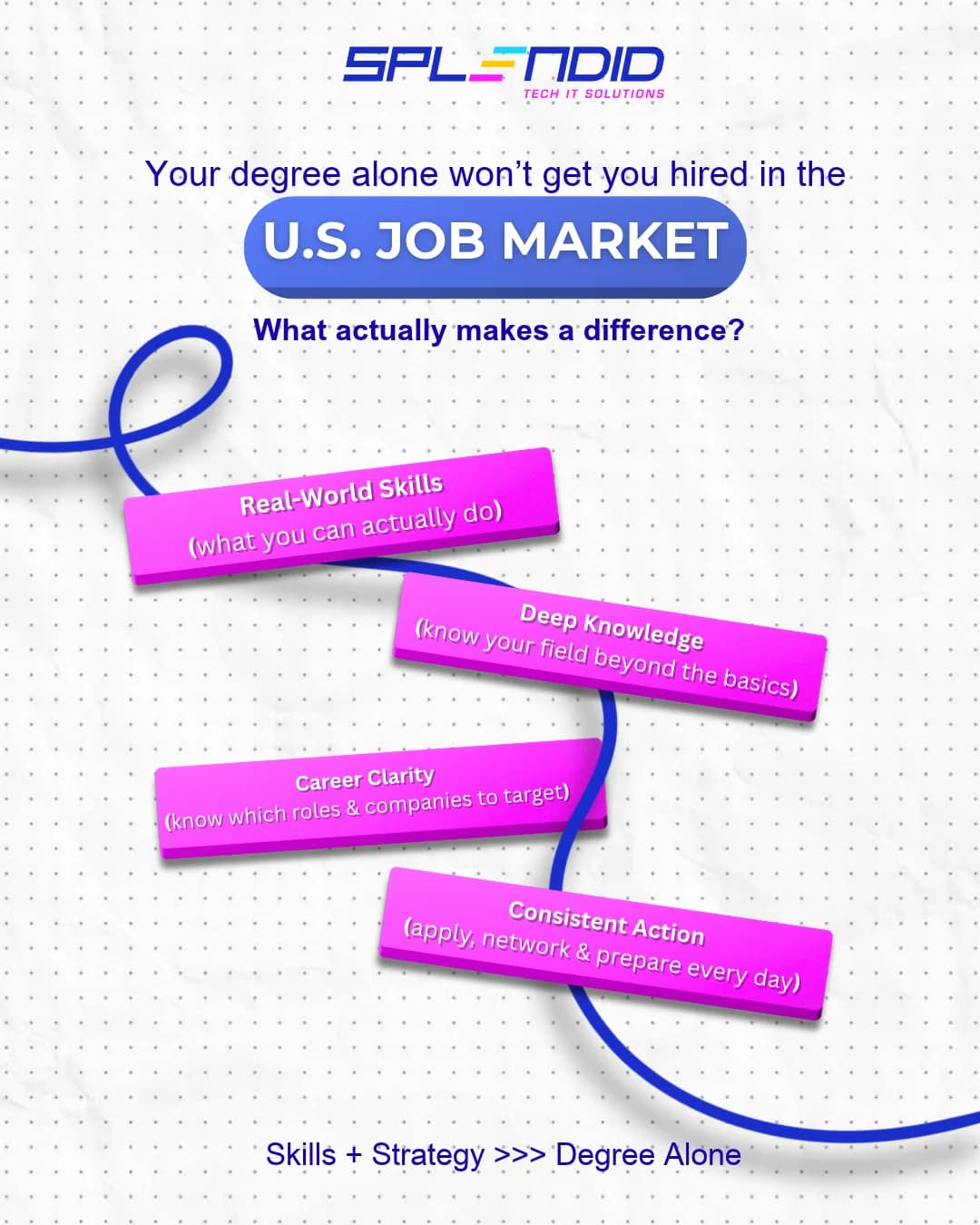
The good news: that gap can be fixed. Most international students who struggle after graduation are missing one of four things: real-world skills, deep knowledge, a clear target role, or a steady job search routine. This guide walks through each one, with simple steps you can start this week.
Key takeaways
- A degree is the foundation, not the finish line. Employers look for proof you can apply what you learned.
- Real-world skills: show how you used a tool to solve a problem, not just that you know it.
- Deep knowledge: be ready to explain why you made each choice in your projects, not only what you did.
- Career clarity: pick one or two target roles and tailor your resume to them, instead of sending one resume to every opening.
- Consistent action: treat the job search like a weekly routine with goals, tracking and practice.
1. Real-world skills: can you use what you learned?
Knowing a concept in class is different from using it to solve a real problem. Employers want to see the second one.
Take a data analytics graduate who knows SQL, Python, Excel and Tableau. In an interview, the question usually isn't "Do you know SQL?" It's "Tell me about a time you used SQL to find a problem in the data. What did you find, and what did you do about it?"
The same goes for software engineering. Knowing Java or Python is the starting point. Interviewers also want to see problem-solving, debugging, basic system design and how you work with a team.
How to build practical skills:
- Build projects that look like the job. If you want a data analyst role, analyze a real public dataset and write up what you found, the way you would for a manager.
- Solve problems, don't just watch tutorials. Tutorials feel productive, but interviews test whether you can work something out on your own.
- Write down what you did and why. A short project summary makes it much easier to talk about your work later.
- Keep a portfolio if your field uses one, such as GitHub for developers or a few dashboards for analysts.
- Prepare the story of each project: the problem, what you tried, what went wrong and what you'd do differently.
You don't need to know everything. You need to show you can apply what you know, learn fast and help the team.
2. Deep knowledge: do you understand your field beyond the basics?
Listing skills on a resume is easy. Explaining them under pressure is not.
If your resume says Python, SQL, AWS and machine learning, expect follow-up questions: Why did you choose that model? How did you handle missing data? What were the limits of your solution? If you can't answer questions about your own resume, a long skills list can hurt more than it helps.
How to go deeper:
- Get the fundamentals solid. Know the core concepts of your target role well enough to explain them simply.
- Practice explaining your work out loud. Describe each project in two minutes: the problem, your approach, the result.
- Learn from what broke. Understand why an approach failed and what you'd change. Interviewers often ask exactly this.
- Expect "why" questions. Interviewers care about your reasoning, not just the steps.
- Only list skills you can defend. If you've only touched a tool once, leave it off or be honest about your level.
Deep knowledge is what makes you sound confident in interviews, because you're not guessing.
3. Career clarity: do you know which role you're going after?
One of the most common mistakes is applying to everything. A student might apply for data analyst, business analyst, software developer, project coordinator and machine learning roles, all with the same resume.
Some people genuinely fit several of these. But each role asks for different skills and a different story. When your applications aren't focused, recruiters can't quickly see why you're a strong fit, and your resume blends into the pile.
How to get clear:
- List your strengths honestly: your degree, projects, internships, technical skills and what you actually enjoy.
- Pick one or two target roles that match your background. You can widen the search later.
- Study 10 to 15 job descriptions for each role. Note the requirements that keep coming up and compare them with your skills.
- Tailor your resume to each role type. Put the most relevant experience first, without exaggerating anything.
- Learn what the role really does day to day, so you can talk about the problems you'd help solve.
On OPT, this isn't just strategy. USCIS says all OPT work must be directly related to your major area of study, so a target role that clearly fits your degree also keeps you on the right side of the rules.
Clarity doesn't lock you in forever. It gives you a clear starting point and a story recruiters understand. If you're not sure which roles fit you best, our Career Strategy & Role Clarity service is built for exactly this question. Our guide to breaking into Java, QA and BA roles compares three common entry points.
4. Consistent action: are you working on your search every week?
A job search isn't something you do when you have free time. It's a set of tasks: finding the right openings, tailoring your resume, networking, preparing for screening calls, practicing interviews and following up.
Two patterns slow people down. Some students apply for hours every day but never check whether it's working. Others wait to practice interviews or reach out to people until an interview is already booked. Both make the search longer and more stressful.
How to build a weekly routine:
- Set a realistic weekly goal for focused, relevant applications. Quality beats volume.
- Block time for networking. A short, polite message to an alumnus or someone in your target role can lead to a referral. Our Networking & Alumni Introductions service helps with this.
- Practice interview questions for your target role every week, not only when an interview is scheduled. See Interview Prep.
- Track everything: applications, replies, screening calls and interviews. A simple spreadsheet works.
- Review every two weeks. If you're applying a lot but getting no replies, the resume or the targeting needs to change, not the number of applications. Our Resume Overhaul service fixes exactly that.
- Reply to recruiters quickly and show up to every call on time.
Consistency doesn't mean doing the same thing over and over. It means keeping up the effort while adjusting based on what the results tell you.
When should you start preparing?
Ideally, long before graduation. Your time at university is the best time to build projects, explore internships where you're eligible, make professional connections and learn what employers expect.
Check how an internship affects your OPT first. If you do an internship on pre-completion OPT, USCIS says that time is deducted from your post-completion OPT. CPT (Curricular Practical Training) works differently, but it has a limit too: according to Study in the States, 12 months or more of full-time CPT makes you ineligible for OPT. Ask your DSO before you accept an internship.
If you're already on OPT, don't panic, but don't wait either. On post-completion OPT, you can be unemployed for a limited number of days in total, so time matters. Our guide to the 90-day OPT unemployment rule explains how the days are counted.
Ask yourself these questions to find your biggest gap:
- Am I targeting roles that match my background?
- Does my resume show my strengths clearly in the first few lines?
- Can I explain my projects and experience with confidence?
- Am I building real professional relationships?
- Am I practicing interviews every week?
- Do I understand the work authorization rules for my situation?
For official OPT and STEM OPT rules, check USCIS and talk to your school's DSO (Designated School Official).
Your degree is the foundation, not the finish line
Your degree matters. It shows years of effort, learning and investment. But getting hired means showing what you can do with it.
You don't have to fix everything at once. Pick your biggest gap from the four above and work on it this week. Small, steady improvements add up faster than you think.
Want help finding your biggest gap?
If you're applying but not hearing back, Splendid Tech can help you figure out why. We work with international students on the parts of the search that matter most: choosing the right roles, rebuilding the resume, improving your LinkedIn, reaching the right people and preparing for interviews. We'll be honest with you: no one can guarantee a job offer, and the work still depends on you showing up prepared. But you don't have to figure it out alone.
Book a Free Strategy Call and we'll look at where you stand and what to do next.
This article is general career information, not legal or immigration advice.
Information only: this article shares general information, not legal or immigration advice. Rules change, so check the official sources linked above and confirm your own situation with your school's DSO or an immigration attorney.
Frequently asked questions
Why can't I get a job after graduating in the U.S. as an international student?
Often it's not the degree. Employers want proof you can do a specific job: practical skills, a clear understanding of your own projects, a resume tailored to one target role, and steady networking and interview practice. A gap in any of these can keep interviews from coming.
Is a U.S. degree enough to get hired?
It's an important foundation, but usually not enough on its own. Employers also look at whether you can apply your skills, explain your work and show you fit the role you're applying for.
Should I apply to many different types of roles?
It's usually better to focus on one or two target roles and tailor your resume to each. Sending the same resume to very different jobs makes it harder for recruiters to see why you're a strong fit.
How many jobs should I apply to each week?
There's no magic number. Set a realistic weekly goal for focused, relevant applications, and review your results every two weeks. If you're getting no replies, change your resume or targeting before you increase volume.
When should international students start preparing for the U.S. job market?
Ideally well before graduation, by building projects, exploring internships where eligible and making professional connections. If you're already on OPT, start immediately, because post-completion OPT limits how many days you can be unemployed.
Stuck in your own job search?
Tell us where you are. We'll tell you honestly whether we can help.
Book a free call

