


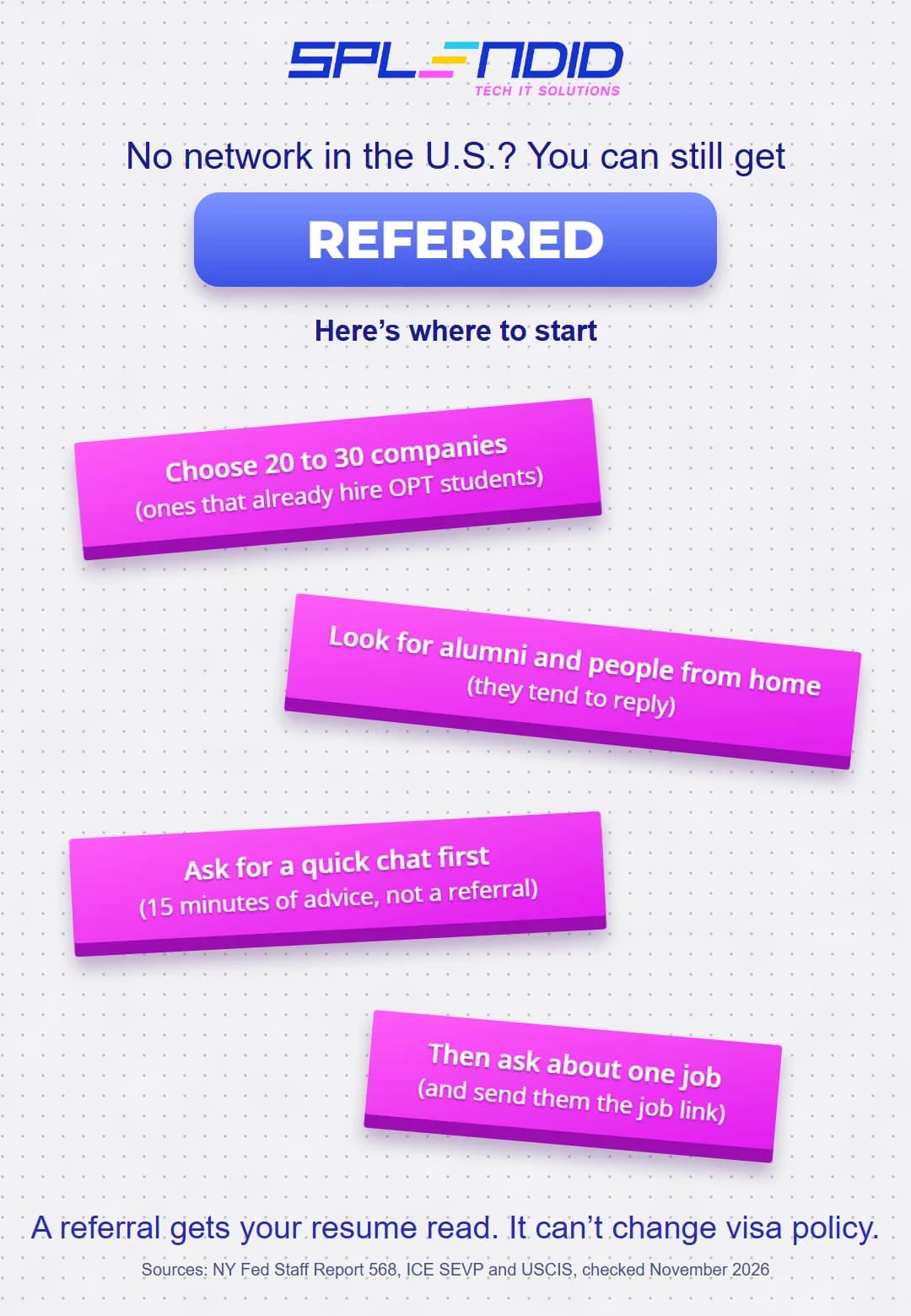
To get a job referral as an international student, don't start by asking for one. Start by finding people who share something with you, like your school, your home country or a past employer. Ask them for a short chat about their team, then ask for a referral to one specific job, with the job ID ready.
That's the whole method. The rest of this guide shows you who to contact, what to write, and how to handle the visa question without hurting your chances.
Key takeaways
- A referral means someone inside the company puts your name forward. It usually means a person reads your resume, which is hard to get when you apply online.
- Ask for advice first, a referral second. People refer someone they've spoken to. They rarely refer a stranger with a one-line message.
- Your best contacts are people who share something with you: alumni, people from your home country, and former colleagues.
- Always ask for one specific role and send the job link or ID. Make it easy to say yes.
- A referral doesn't change whether a company sponsors visas. Target employers that already hire international students first.
Why referrals matter so much on OPT
A job referral is when a current employee puts your name forward for a specific opening, usually through the company's internal referral system.
When you apply online, your resume joins a pile. Often nobody looks at it closely. A referral usually gets it read by a person, because someone at the company has vouched for you.
Research backs this up. A Federal Reserve Bank of New York study looked at hiring data from one U.S. company. It found that referred candidates were more likely to be hired, and that referred workers stayed with the company longer. It's one company's data, but it's a useful signal.
For international students, there's another reason referrals matter: time. If you're on post-completion OPT, you get 90 days of unemployment (150 in total if you move to STEM OPT), according to Study in the States. Sending 300 cold applications and waiting is a slow way to spend those days. Read our guide to the 90-day OPT unemployment rule if you're not sure where your clock stands.
One honest warning: a referral gets you seen, but it doesn't change company policy. If a company doesn't sponsor visas for your role, a referral won't change that. So pick your target companies first.
Step 1: Pick your target companies before you message anyone
Referrals work best when you aim them. Before you contact anyone, build a list of 20 to 30 companies that:
- hire for the one or two roles you're targeting, and
- have a track record of hiring international students.
Two free, official places to check:
- ICE's list of the top 200 OPT employers. ICE's 2024 list shows which employers hired the most OPT and STEM OPT students. These companies already know how to hire someone like you.
- The USCIS H-1B Employer Data Hub. The official data shows which employers have filed H-1B petitions. Useful if you'll need sponsorship after OPT.
If you're still applying to every role that matches your degree, slow down here. A clear target makes every message stronger. Our guide to getting a tech job on OPT walks through how to choose.
Step 2: Find the right people at those companies
A few people with a reason to reply to you is enough.
Start with the people who are most likely to say yes:
- Alumni from your school. On LinkedIn, go to your university's page and open the Alumni tab. You can filter by where people live, where they work, what they do and what they studied. Alumni tend to reply more often because you share something real.
- People from your home country. Someone who came to the U.S. on an F-1 visa and now works at your target company knows what you're going through. Many of them are happy to help.
- Former classmates and seniors. The person who graduated a year or two before you is often the most willing to help.
- Former colleagues. If you worked before your master's, check where your old teammates and managers are now.
- People you meet in person. Career fairs, meetups and tech events give you a face-to-face start, which makes the later ask much easier.
Who to aim for: an engineer, analyst or manager on or near the team you want, not a senior executive. People in similar roles understand the job, and the hiring team will listen to them.
Step 3: Ask for a conversation, not a referral
Many students start by sending a stranger a message that says, "Can you refer me?" Many people ignore that, because they don't know you and don't want to recommend someone they've never spoken to.
Instead, ask for 15 minutes of advice. Here are messages you can copy. Change the details so they sound like you.
LinkedIn connection note (keep it short):
"Hi Priya, I'm a fellow [University] grad, finishing my master's in data science. I saw you're a data analyst at [Company]. I'd love to hear how you got there. Would you be open to a quick chat?"
If they accept, send a short follow-up:
"Thanks for connecting! I'm looking at data analyst roles, and [Company] is high on my list because of [one real reason: a product, a team, a project you read about]. Would you have 15 minutes this week or next to tell me what the team looks for? Happy to work around your schedule."
If they don't reply, follow up once after about a week:
"Hi Priya, just bumping this in case it got buried. Totally understand if you're busy. Thanks either way!"
After one follow-up, move on. No reply usually means busy, not rude.
Step 4: Make the chat count
Keep the chat relaxed. Bring three or four real questions:
- What does a typical week look like on your team?
- What skills matter most for someone joining at my level?
- How did you get your role here?
- Is the team hiring right now, and does it hire international students?
Listen more than you talk. Near the end, if it went well, ask directly:
"This was really helpful, thank you. I'm planning to apply for the Data Analyst role, job ID 12345. Would you be comfortable referring me? I can send my resume and a short summary so it's easy."
That last line matters. Make it easy. Send them:
- the job link or ID,
- your resume, tailored to that role, and
- two or three sentences about why you fit, which they can paste into the referral form.
If your resume isn't getting callbacks on its own yet, fix that first. A referral gets your resume read, so it has to be ready.
When and how to mention your visa
Be honest, and bring it up at the right moment.
You don't need to open your first message with "I'm on OPT." But during the chat, it's fair to ask, "Does your team hire people on OPT or STEM OPT?" That tells you early whether a referral can lead anywhere.
If they ask about your status, keep it short and confident:
"I'm authorized to work on OPT through [month, year], and my degree qualifies for the 24-month STEM OPT extension with an E-Verify employer. I'd need sponsorship after that."
Only mention STEM OPT if your degree is on DHS's STEM Designated Degree Program List. The employer must use E-Verify and sign Form I-983 with you.
Never hide your status. It usually comes out when HR checks your work authorization, and the person who referred you will feel misled. For more scripts, read our guide on how to answer the visa sponsorship question.
Mistakes that cost referrals
- Mass copy-paste messages. People can tell. One personal message beats ten generic ones.
- Asking for a referral in the first line. Ask for advice first.
- Asking for "any role." Nobody can refer you to everything. Name one job.
- Not sending the job ID. Make the referrer's job take two minutes, not twenty.
- Disappearing after they help. Thank them, and tell them how it went. People remember that, and they're more likely to help again.
- Pushing after a no. If they say they can't refer you, thank them and stay in touch.
How many messages should you send?
Do a little every week. Sending 50 messages in one night and then stopping rarely works.
A realistic week might look like this:
- 10 to 15 personal messages to alumni and contacts at your target companies
- 2 to 4 short chats
- 1 or 2 referral requests, each tied to a specific job
Keep a simple spreadsheet: name, company, date you messaged, reply, next step. That way you won't forget anyone.
What if you have no network at all?
Lots of international students feel this way. You arrived a year or two ago, spent most of it studying, and now everyone says "network." That's normal, and it's fixable.
Start small:
- Join your school's alumni groups on LinkedIn and attend one alumni event.
- Go to one local tech meetup or career fair a month.
- Reconnect with classmates who already have jobs.
- Comment thoughtfully on posts from people at your target companies before you message them.
Within a few weeks, you should have more people to talk to. If you'd rather not do it alone, our Networking & Alumni Introductions service helps you find the right people inside your target companies and write outreach that gets replies.
Want help getting referred?
If your messages aren't getting replies, or you're not sure which companies to target, Splendid Tech can help. We work one-on-one with international students on the whole search. We help you pick roles and companies, write outreach and prepare for interviews.
Book a Free Strategy Call and we'll look at where you stand and what to do next.
Information only: this article shares general information, not legal or immigration advice. Rules change, so check the official sources linked above and confirm your own situation with your school's DSO or an immigration attorney.
Frequently asked questions
How do I get a referral if I don't know anyone at the company?
Look for people who share something with you, like alumni from your school, people from your home country or former colleagues. Ask them for a short chat about their team first. Once you've spoken, ask for a referral to one specific job and send the job ID.
Is it okay to ask a stranger for a referral on LinkedIn?
You can, but a cold "please refer me" rarely works. People are much more willing to refer someone they've spoken to. Ask for 15 minutes of advice first, then ask for the referral at the end of a good conversation.
Does a referral help with visa sponsorship?
No. A referral gets your resume seen, but it doesn't change a company's sponsorship policy. Target employers that already hire international students, using sources like ICE's top OPT employers list and the USCIS H-1B Employer Data Hub.
Should I tell the person referring me that I'm on OPT?
Yes, be honest. You don't have to lead with it, but ask during the chat whether the team hires people on OPT or STEM OPT. If they ask about your status, say how long you're authorized to work and that you'd need sponsorship after that.
What should I send someone who agrees to refer me?
Send the job link or ID, your resume tailored to that role, and two or three sentences on why you fit. That makes the referral quick and easy for them.
How long should I wait before following up?
About a week. Send one short, polite follow-up. If there's still no reply, move on to someone else. No reply usually means the person is busy.
Stuck in your own job search?
Tell us where you are. We'll tell you honestly whether we can help.
Book a free call

