


When recruiters don't respond on LinkedIn, common reasons include messaging someone who doesn't hire for your role, a message that doesn't say what you want, or a profile that doesn't match the job. Recruiters also get a lot of messages and simply miss some. You can't control their inbox. You can make your message quick to answer, and make sure your profile backs it up.
Key takeaways
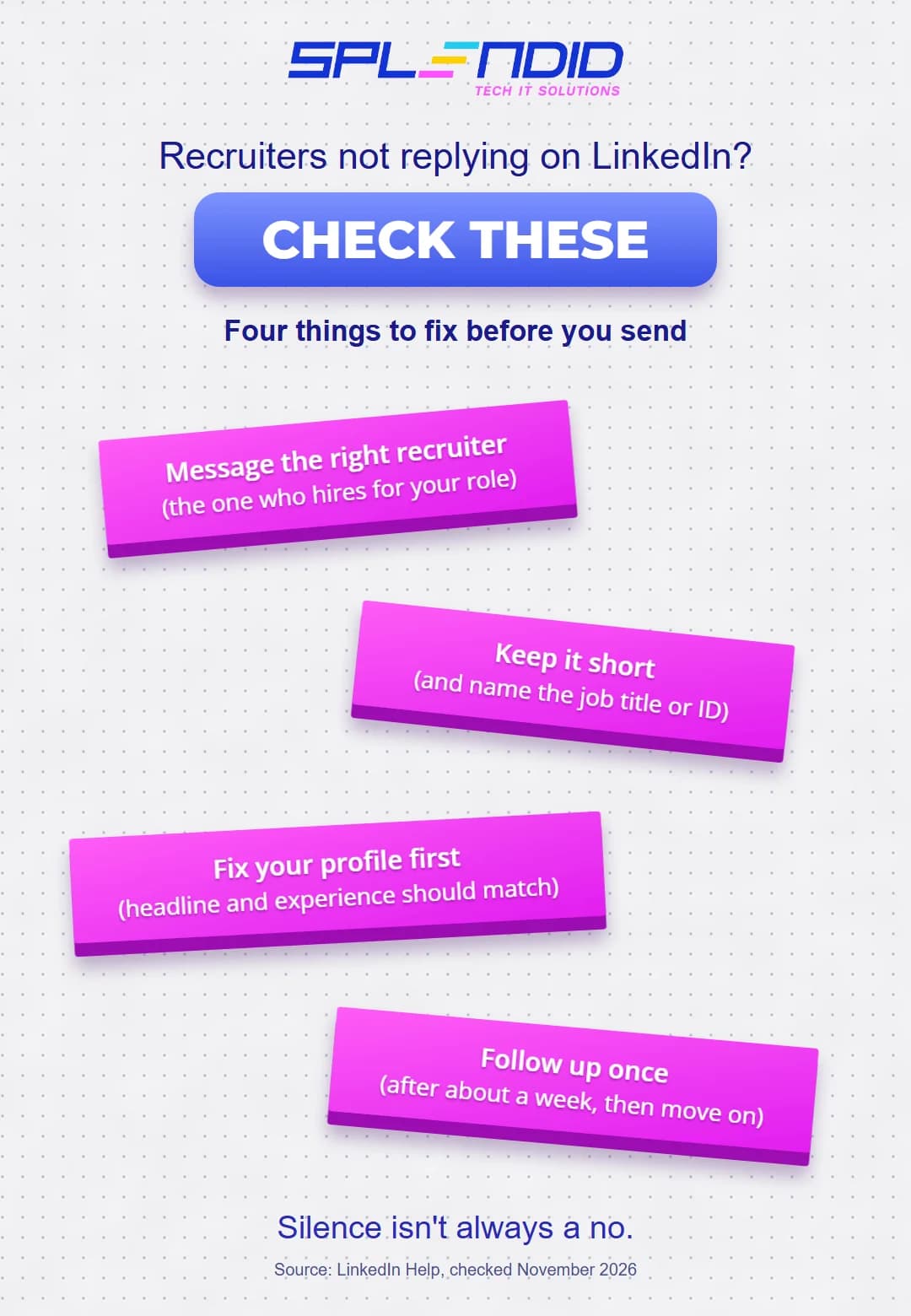
- Message the recruiter who hires for your kind of role, at a company where you've applied or want to.
- Keep it short: who you are, which job, and one specific question.
- Include the job title or job ID.
- Make your headline and recent experience match the job before you send anything.
- Follow up once, after about a week, then move on.
1. Wrong recruiter, wrong team
Big companies have many recruiters, and each one usually covers certain teams or kinds of roles. A recruiter who hires sales staff can't do much with your data analyst application.
Before you message someone, look at their profile and recent posts. Their headline or job posts often say what they recruit for, like "Technical Recruiter" or "University Recruiting." If you can, find the recruiter named on the job post or the one who posted it.
Agency recruiters, who work for staffing firms, are different from in-house recruiters, who work for the company itself. Both can help, but in-house recruiters work directly on their own company's roles.
2. The message is too vague
Messages like "Hi, I'm looking for opportunities, please let me know if anything fits" are hard to answer. The recruiter would have to read your whole profile and guess what you want.
Make it easy. A good first message is three or four sentences:
"Hi Sarah, I applied for the Data Analyst role on your team (job ID 12345). I have a master's in business analytics and built SQL and Tableau reporting for a retail client during my internship. Is this role still open, and is there anything you'd like me to add to my application?"
It's short, it's about one job, and Sarah can answer it in one line.
3. Does your profile match the job?
When a recruiter gets your message, they'll probably click your profile. If your headline says "Student at [University]" and your experience section is empty, they don't have much to go on.
Before you send messages:
- Write a headline with your target role and key skills, for example "Data Analyst | SQL, Python, Tableau | Master's in Business Analytics."
- Make your experience match your resume, with the same roles, dates and results.
- Add a short About section that says what you do and what you're looking for.
- Pin a project or two that fit the roles you want.
Our free LinkedIn Checklist goes through each section. Our guide to LinkedIn headline examples for international students has ready-to-adapt headlines.
4. Recruiters can't find you
Recruiters also look for people, not only answer messages. LinkedIn's Open to Work setting lets you tell them you're looking. According to LinkedIn Help, you can show it to all LinkedIn members, which "also includes recruiters and people at your current company," or to recruiters only, meaning "people using LinkedIn Recruiter only." LinkedIn also says it takes steps to stop LinkedIn Recruiter users at your current company from seeing it, but "we can't guarantee complete privacy."
Add the job titles and locations you want, so the right searches find you.
5. Asking for a referral in the first message
"Can you refer me?" or "Can you get me an interview?" in the first message asks a stranger for a favor. That's a lot to ask of someone who doesn't know you yet.
Ask something small first: whether the role is still open, what the team looks for, or whether you should apply directly. Once you're talking, asking for a referral feels less strange.
6. The visa question took over the message
It's natural to worry about sponsorship. But if the first line of your message is about your visa, the recruiter learns nothing about why you'd be good at the job.
Lead with your fit for the role. The work authorization conversation often comes up on the application or in the first call, and you should answer honestly when it comes up. Our guide on how to answer "Do you require visa sponsorship?" has scripts.
7. Following up: once is enough
Recruiters are busy. One polite follow-up after about a week is normal:
"Hi Sarah, just following up on my note about the Data Analyst role. Happy to send anything that helps. Thanks either way!"
If there's still no reply, move on. Don't keep sending more messages.
When it's not about you
Sometimes the role is already filled, put on hold or about to close. Sometimes the recruiter is on leave or has a full inbox. Silence doesn't always mean no.
That's why it helps to work with several companies at once, and to reach people other than recruiters, like alumni or engineers on the team. Our guide on finding visa sponsorship jobs on LinkedIn shows how to build that list.
Keep a simple tracker
Write down the name, company, role, the date you messaged, any reply and your next step. It stops you from following up twice or forgetting someone.
When it's more than one bad message
If you've fixed your messages and you're still hearing nothing, look at the bigger picture:
- you've messaged 20 or more recruiters with almost no replies
- recruiters view your profile but don't follow up
- you're not sure your profile matches the roles you apply for
- your OPT days are adding up while you wait
Get a second opinion on a free call
Splendid Tech's LinkedIn & Online Presence service rewrites your profile from headline to experience, so recruiters see a clear fit when they click.
On a free 30-minute strategy call, we'll look at your profile and a couple of the messages you've sent, and tell you what to change first.
No pressure. No pitch.
Book a Free Strategy Call and pick a time that works for you.
Information only: this article shares general information, not legal or immigration advice. For questions about your own status, ask your school's DSO or an immigration attorney.
Frequently asked questions
Why do recruiters not respond on LinkedIn?
Common reasons are messaging a recruiter who doesn't hire for your role, a message that doesn't say what you want, or a profile that doesn't match the job. Recruiters also get many messages and miss some.
What should I say in a message to a recruiter on LinkedIn?
Keep it to three or four sentences: who you are, the job title or job ID, one reason you fit, and one simple question, such as whether the role is still open.
How long should I wait before following up with a recruiter?
About a week. Send one short, polite follow-up. If there's still no reply, move on to other roles and people.
Who can see my Open to Work status on LinkedIn?
According to LinkedIn Help, you can share it with all LinkedIn members, which includes recruiters and people at your current company, or with recruiters only, meaning people using LinkedIn Recruiter. LinkedIn says it can't guarantee complete privacy.
Should I mention my visa in my first message to a recruiter?
Lead with why you fit the role. Work authorization often comes up on the application or in the first call, and you should answer honestly when it does.
Is it better to message a recruiter or apply directly?
Do both. Apply through the job post, then send the recruiter a short message that mentions the job.
Stuck in your own job search?
Tell us where you are. We'll tell you honestly whether we can help.
Book a free call

