


A reverse recruiting or job application service is a company you pay to run part of your job search for you. Usually that means finding openings and sending applications in your name, and sometimes it includes tailoring your resume or reaching out to recruiters. It can be worth it if you already know which roles you want and the main thing missing is time. It's a poor fit if you're still unsure what to target, or if your resume and interviews aren't working yet.
For international students on OPT, there are a few extra things to check.
Key takeaways
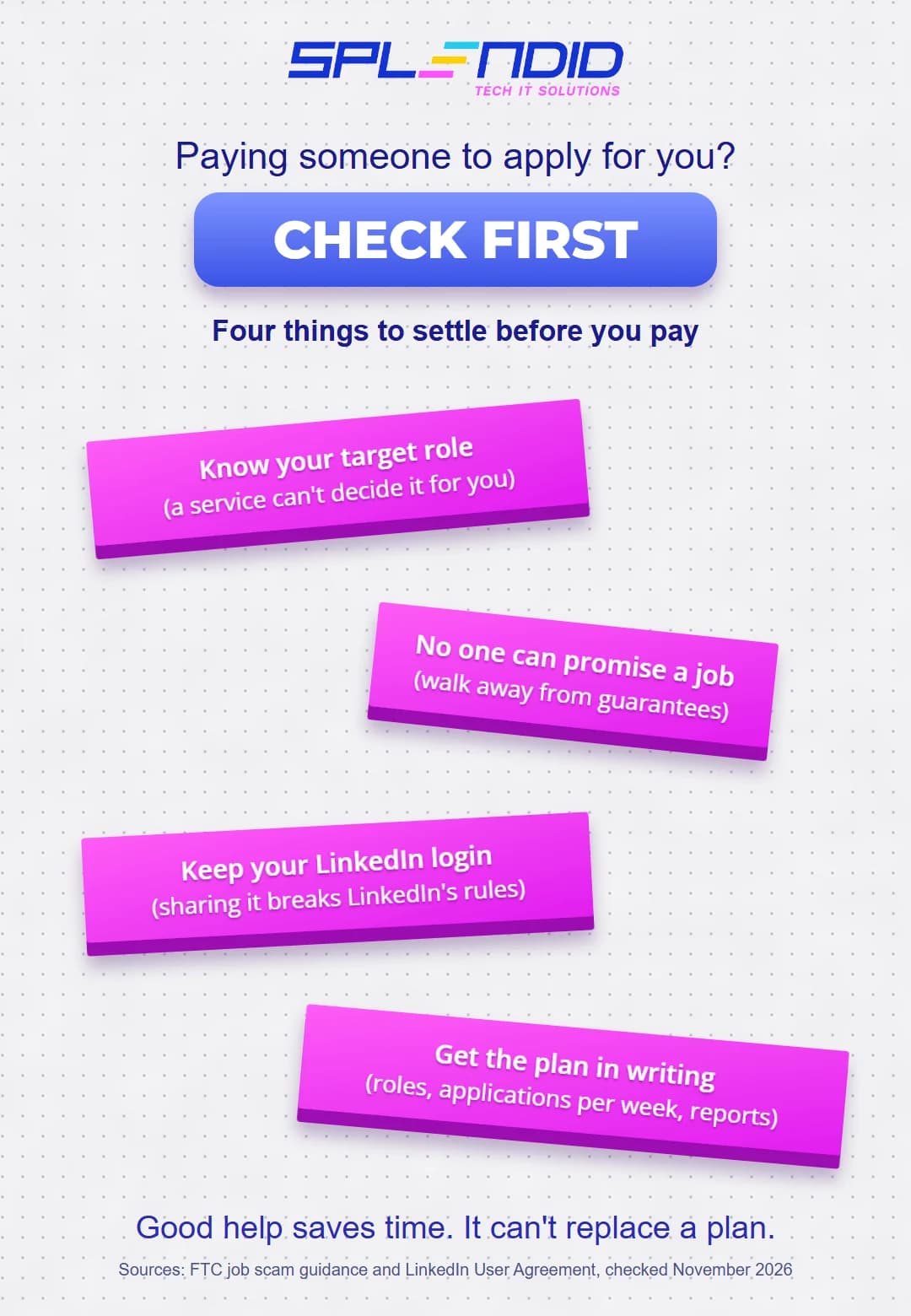
- These services can save you time. They don't fix unclear targeting, a weak resume or interviews that don't turn into offers.
- Nobody can honestly promise you a job. The FTC warns: "Don't pay for the promise of a job."
- Ask how they'll apply for you. Sharing your LinkedIn login breaks LinkedIn's user agreement.
- Get the plan in writing: roles, number of applications per week, and what reports you'll see.
- On OPT, make sure they only target employers that can hire you.
What these services actually do
The names vary: reverse recruiter, job application service, done-for-you applications, job search agent. Most offer some mix of:
- finding job openings that match your target role
- filling in and sending applications for you
- tailoring your resume or cover letter for each application
- reaching out to recruiters or hiring managers
- a tracker or regular report of what was sent
Pricing varies a lot. Some charge a flat fee or a monthly fee. Some ask for a share of your first-year salary once you're hired. Make sure you know which model you're signing up for, and what happens if you stop early.
When it can be worth it
These services work best when the missing piece is time and steady effort:
- you already know your one or two target roles
- your resume gets replies when you send it to the right jobs
- you can handle interviews once you get them
- you're busy with a job, classes or a thesis and can't apply every day
If that's you, handing off the repetitive work can free hours each week for networking and interview practice.
When it's probably not worth it
Paying someone to send more applications won't help if the problem is somewhere else:
- You're applying to five different kinds of roles. More applications to the wrong roles just means more silence.
- Your resume gets almost no replies. Sending it more often won't change that.
- You get interviews but no offers. That's an interview problem. Our guide to getting interviews but no job offers covers it.
If you're not sure which of these applies to you, look at your last month of applications. Our guide on why you're not getting interview calls shows how to find where your search is breaking.
Extra checks for international students on OPT
A service that mostly works with U.S. citizens may not know your situation. Ask:
- Will you only apply to employers that hire people on OPT or STEM OPT? Applying to roles that truly require U.S. citizenship, like many jobs that need a security clearance, wastes your time and money.
- Do you check which employers have hired OPT students or sponsored H-1B workers before? Public sources like the USCIS H-1B Employer Data Hub and ICE's list of top OPT employers show this.
- How do you answer the sponsorship question on applications? It should be answered honestly. Our guide on how to answer "Do you require visa sponsorship?" explains why.
- Can you move fast? On post-completion OPT you have a limited number of unemployment days. Study in the States lists 90 days, or 150 in total with STEM OPT.
A career service should help with your job search, not your immigration case. If anyone gives you advice about your visa status, check it with your school's DSO or an immigration attorney.
Red flags
Walk away, or at least slow down, if you see any of these.
A job guarantee. The FTC's guidance on job scams says: "Don't pay for the promise of a job." Paying for help with your search is different from paying for a promised job. Nobody can promise you an offer.
A request for your LinkedIn password. LinkedIn's User Agreement says: "You will not share your account with anyone else." It also says members shouldn't use another person's account, "such as sharing log-in credentials." Ask how they'll apply for you without logging in as you.
No written plan. You should know which roles they'll target, roughly how many applications they'll send each week, and how you'll see what was sent.
Applications you can't see. If you don't know where you applied, you can't prepare when a recruiter calls. Ask for a tracker or a weekly report that lists every application.
Pressure to pay today. Anyone worth paying will still be there next week.
Questions to ask before you pay
- What exactly do you do each week, and what do I still do myself?
- Which roles and companies will you target, and who decides?
- How many applications per week, and can I see each one?
- Will you change my resume, and do I approve it first?
- Do you need my passwords? If so, why?
- How is the fee charged: flat, monthly, or a share of my salary?
- What happens if I find a job on my own, or want to stop?
Write the answers down. If a service avoids a question, take note.
What to do instead, or alongside
Whether or not you hire help, the basics stay the same. Pick one or two roles and keep a resume for each. Build a list of employers that hire international students for that role. Spend some time every week talking to people, not only applying, and practice before the interviews that matter.
Is it time to hand some of this off?
Paying for application help makes the most sense when:
- you already know the one or two roles you want
- applying is eating your evenings, and there's no time left to prepare
- you're working, studying or finishing a thesis at the same time
- your OPT days are adding up and you need a steady pace
If that's you, the right help gives you your time back for networking and interview practice.
Talk it through on a free call
Splendid Tech's Done-For-You Job Applications service sends targeted applications for you, screened for your background and visa situation. It's one part of a full plan that also covers your resume, LinkedIn, networking and interview prep. We charge flat fees, never a cut of your salary, and we don't promise jobs.
On a free 30-minute strategy call, we'll look at where your search is stuck and tell you honestly whether handing off applications would help, or whether something else should come first.
No pressure. No pitch.
Book a Free Strategy Call and pick a time that works for you.
Information only: this article shares general information, not legal or immigration advice. Rules change, so check the official sources linked above and confirm your own situation with your school's DSO or an immigration attorney.
Frequently asked questions
What is a reverse recruiter?
A reverse recruiter works for you, the job seeker, instead of for the employer. They usually find openings and apply on your behalf, and some also tailor your resume or contact recruiters for you.
Are job application services worth it?
They can be if you already know your target roles, your resume gets replies, and your main problem is time. They're less useful if you're unsure what to target or your resume and interviews aren't working yet.
Can a job application service guarantee me a job?
No one can honestly promise a job. The FTC's advice on job scams is "Don't pay for the promise of a job."
Should I give a service my LinkedIn password?
LinkedIn's User Agreement says you will not share your account with anyone else, and it lists sharing log-in credentials as a way of using another person's account. Ask the service how it applies without logging in as you.
What should international students on OPT check before hiring one?
Check that the service only applies to employers that hire people on OPT or STEM OPT, answers the sponsorship question honestly, and can move quickly, because post-completion OPT allows a limited number of unemployment days.
How do these services charge?
Pricing varies. Some charge a flat or monthly fee, and some take a share of your first-year salary. Ask which model they use and what happens if you stop early.
Stuck in your own job search?
Tell us where you are. We'll tell you honestly whether we can help.
Book a free call

