


If you're getting interviews but no job offers, your resume is probably doing its job. Recruiters are picking you. Something is going wrong later, in one round of the process.
The fix starts with finding which round. Students who keep getting cut after the recruiter call need different help. Students who reach the final round and then hear nothing need something else. This guide walks you through each round, what usually goes wrong for international students, and what to change.
Key takeaways
- Getting interviews usually means your resume and targeting are working. Don't rewrite everything. Find the one round you keep losing.
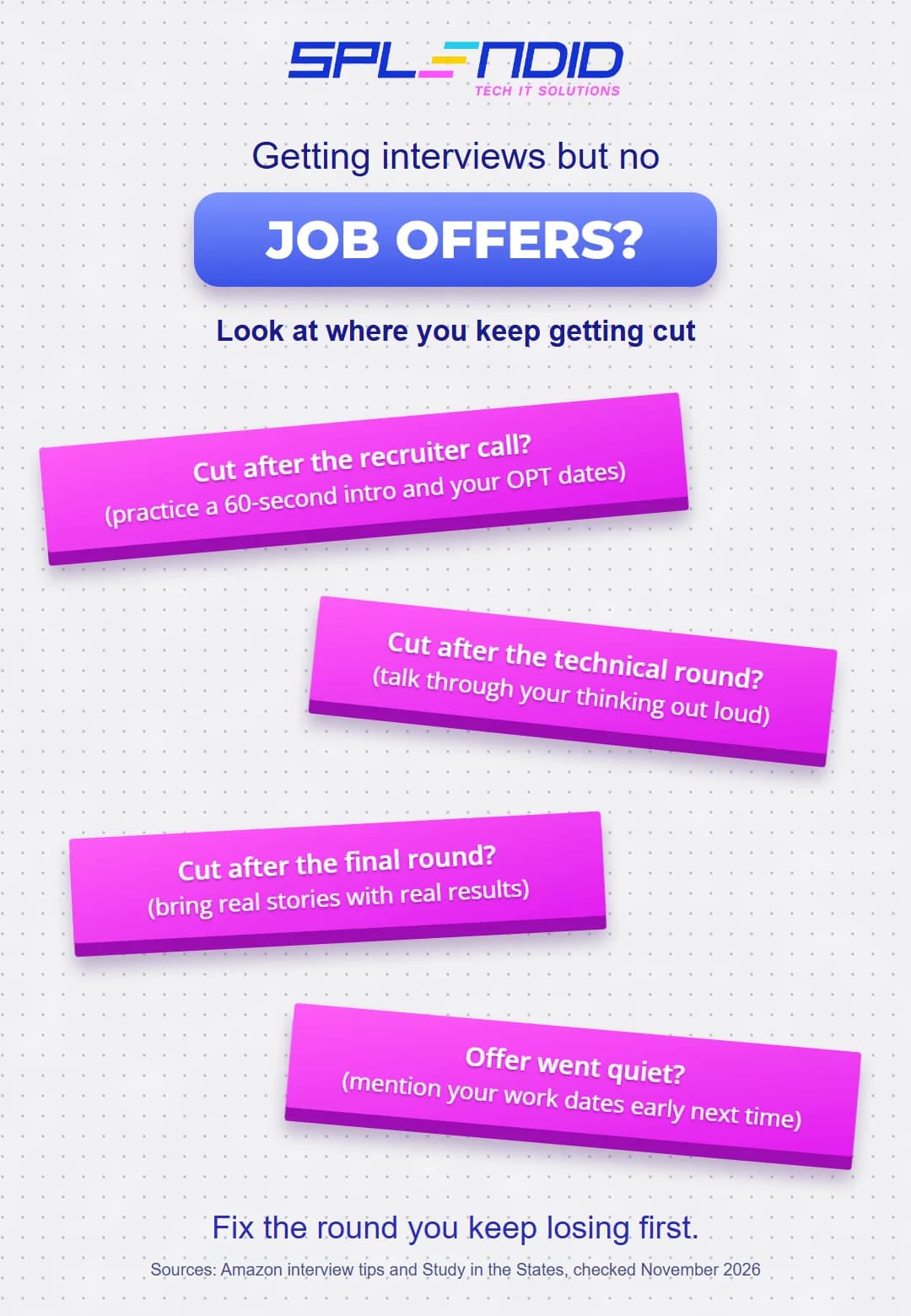
- Recruiter screen: practice a short pitch, know your OPT dates, and know why you want this company.
- Technical round: talk through your thinking out loud. If you go quiet, it can look like you're stuck.
- Final and behavioral rounds: prepare real stories with what you did and what changed because of it.
- The visa question: say your work dates early and honestly. It's much worse when it comes up at the offer stage.
- Ask for feedback after every rejection. Some recruiters will tell you, and one honest answer can show you what to fix.
First, find the round where you drop out
Look back at your last five to ten interview processes. For each one, write down the last round you reached:
- the recruiter screen (the first phone or video call)
- the technical round (coding, SQL, case study or take-home)
- the final or behavioral round (the hiring manager, a team panel, "tell me about a time")
- the offer stage (you heard positive things, then it went quiet or the offer was pulled)
You'll often see a pattern, with the same stage coming up again and again. That's the stage to fix first. The rest of this guide goes round by round.
Round 1: You keep losing at the recruiter screen
A recruiter screen is the first short call with someone from the company's hiring team. It's short, but it decides a lot. Recruiters usually check three things: can you explain who you are, do you fit the role, and can the company actually hire you.
What often goes wrong:
- A long, unfocused introduction. "Tell me about yourself" turns into a five-minute life story.
- No clear reason for this company. "I'm open to anything" sounds like you applied everywhere, even if it's true.
- A shaky answer about your visa. A vague answer makes the recruiter guess, and that rarely helps you.
What to change:
Write a 60-second pitch and say it out loud until it sounds natural. Keep it to three parts: what you do now, one or two results you're proud of, and why this role.
"I'm a data analyst finishing my master's at [University]. In my last project I built a dashboard that cut our team's weekly reporting time in half [use your own real result]. I'm applying here because your team works on [specific product], and that's exactly the kind of data I want to work with."
Then prepare your work authorization answer. Keep it short and confident:
"I'm authorized to work on OPT through [month, year]. My degree qualifies for the 24-month STEM OPT extension with an E-Verify employer. I'd need sponsorship after that."
For more scripts, read our guide on how to answer "Do you require visa sponsorship?".
Round 2: You keep losing the technical round
Many international students are strong technically and still lose this round. Strong coders still lose this round when the interviewer can't follow how they reached the answer.
What often goes wrong:
- Solving in silence. The interviewer can't see your thinking, so they can't give you credit for it, or a hint when you need one.
- Jumping straight into code. Skipping the clarifying questions makes you look rushed.
- Practicing alone. Solving problems on your own is different from solving them while someone watches you.
What to change:
- Think out loud. Say what you're considering, what you'll try first, and why. It feels strange at first, so practice it.
- Ask one or two clarifying questions before you start. "Can the input be empty?" "Should I focus on speed or readability first?"
- Practice under real conditions. Set a timer, explain your thinking out loud, and get someone to watch. A mock interview with feedback shows you things you can't see on your own.
- Test your own answer before you say "done." Walk through a small example.
Round 3: You reach the final round, then hear nothing
This one hurts the most. You did well technically, you met the team, and then it went quiet.
Final rounds often use behavioral questions: "Tell me about a time you disagreed with a teammate," "Tell me about a mistake you made." These questions show how you work with people.
What often goes wrong:
- No prepared stories. Answers stay general: "I'm a good team player."
- "We" instead of "I." Many students describe what the team did and never say what they did. Interviewers need to hear your part.
- No result. The story ends before anything changed.
What to change: use the STAR method. STAR stands for situation, task, action and result. Amazon calls it "a structured manner of responding to a behavioral-based interview question" in its interview tips. Many companies ask behavioral questions, so the same method works elsewhere.
Prepare six to eight stories from your projects, internships, jobs or class work. Make sure each one covers:
- Situation: where you were and what was going on, in one or two sentences
- Task: what you were responsible for
- Action: what you did, step by step
- Result: what changed, with a number if you have one
One good story can answer several questions. A story about fixing a broken data pipeline under a deadline can work for "a time you were under pressure," "a time you solved a hard problem" and "a time you took ownership."
Round 4: The offer stalls or gets pulled
Sometimes everything goes well, and then the visa question appears at the very end. The company realizes it won't sponsor an H-1B later, or isn't enrolled in E-Verify, which STEM OPT requires. The offer stalls or disappears.
This is painful, and sometimes it's simply company policy. But you can lower the risk:
- Bring up your work dates early, in the recruiter screen, not at the offer stage. If a company won't sponsor or won't support STEM OPT (it must use E-Verify and sign Form I-983 with you), it's better to know in week one than in week six.
- Answer application questions honestly. Your OPT card (EAD) shows its end date when HR does your hiring paperwork, so a "no" to "Will you now or in the future require sponsorship?" won't hold up.
- Spend most of your time on employers that hire international students. ICE's list of the top 200 OPT employers and the USCIS H-1B Employer Data Hub are free places to start.
Ask for feedback after every rejection
Many companies won't give detailed feedback, but some recruiters will share a little if you ask politely. Send a short note within a day or two:
"Thanks again for the chance to interview for the Data Analyst role. I really enjoyed meeting the team. If you're able to share anything I could improve for future interviews, I'd be grateful. Either way, I hope we cross paths again."
Even one honest line, like "the other candidate had more SQL experience" or "your answers were a bit general," tells you where to focus.
Once OPT starts, your clock keeps running
Once your OPT start date has passed, every day without qualifying work counts toward your limit. On post-completion OPT you get 90 days of unemployment, or 150 in total if you move to STEM OPT, according to Study in the States. Interviews don't pause that count. Only qualifying employment that you report does.
That's why it makes sense to fix your weak round quickly, instead of hoping the next interview goes differently. If you're not sure how many days you have left, read our guide to the 90-day OPT unemployment rule.
A simple two-week practice plan
- Days 1 to 2: list your last five to ten interview processes and find the round you lose most.
- Days 3 to 5: write your 60-second pitch and your visa answer, and say both out loud every day.
- Days 6 to 9: write six to eight STAR stories. Cut each one to about two minutes when spoken.
- Days 10 to 14: do at least two mock interviews with someone who will give you honest feedback, focused on your weak round.
Record yourself at least once. Watching it back is uncomfortable, but you'll spot habits you never noticed, like rushing, filler words or answers with no result.
Want help turning interviews into offers?
If you keep getting close but not getting the offer, Splendid Tech runs one-on-one mock interviews with real-time feedback, company-specific practice and a clear plan for the sponsorship conversation.
Book a Free Strategy Call and we'll look at where your interviews are breaking down and what to fix first.
Information only: this article shares general information, not legal or immigration advice. Rules change, so check the official sources linked above and confirm your own situation with your school's DSO or an immigration attorney.
Frequently asked questions
Why do I get interviews but no job offers?
Getting interviews usually means your resume and targeting work. The problem is usually in one round: the recruiter screen, the technical round, the final behavioral round or the offer stage. Look at your last five to ten interviews, find where you usually drop out, and fix that round first.
How do I know which interview round I'm failing?
Write down the last round you reached in each recent interview process. Most people see a pattern, such as always losing after the recruiter call or always losing after the final round. That pattern tells you what to practice.
Should I mention I'm on OPT in an interview?
Be honest and bring it up early, usually in the recruiter screen. Say how long you're authorized to work, whether you're eligible for STEM OPT, and that you'd need sponsorship after that. It's far worse when it comes up at the offer stage.
What is the STAR method?
STAR stands for situation, task, action and result. It's a way to answer behavioral questions like "Tell me about a time you made a mistake" with a clear story. Focus on what you did personally and what changed because of it.
Is it okay to ask a recruiter for interview feedback?
Yes. Send a short, polite note within a day or two of the rejection. Many companies won't share details, but some recruiters will give you a line or two, and that can show you exactly what to work on.
Do job interviews stop my OPT unemployment clock?
No. On post-completion OPT, your unemployment days keep counting until you start qualifying employment and report it. Interviews don't pause the count, so it's worth fixing your weak round quickly.
Stuck in your own job search?
Tell us where you are. We'll tell you honestly whether we can help.
Book a free call

