


If you're on OPT or STEM OPT and not getting interview calls, the cause is usually something you can change. Often it comes down to one of three things: you're applying to roles that can't hire you, your resume isn't making it past the first screen, or you're only sending cold applications. Each of these is quicker to fix than sending another hundred applications.
Here are eight common reasons, and what to change for each one.
Key takeaways
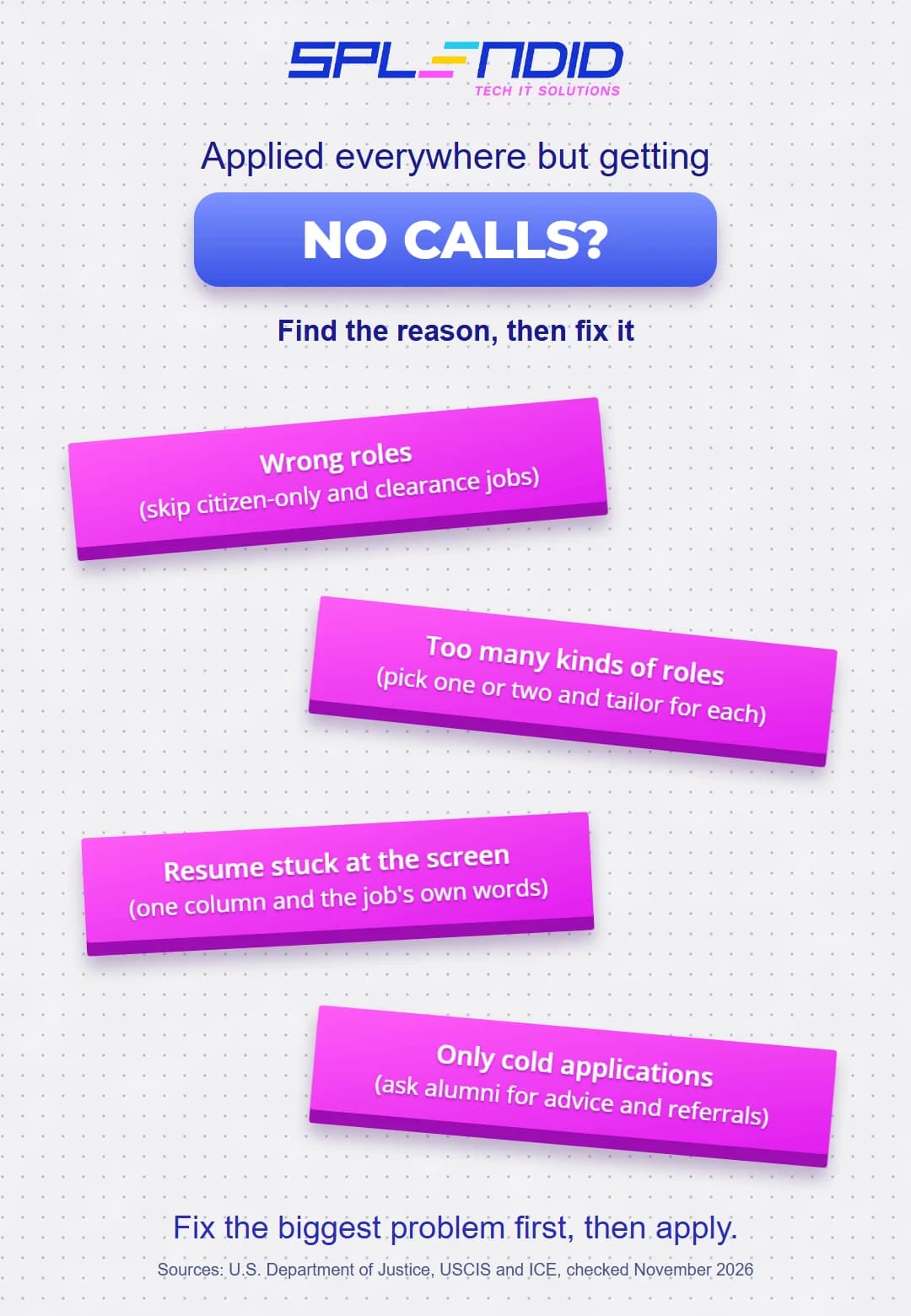
- Look at your numbers first. Lots of applications with almost no replies points to targeting or your resume.
- Skip roles that require U.S. citizenship, such as many jobs that need a security clearance.
- One resume sent to every kind of job rarely works. Pick one or two roles and tailor for them.
- Cold applications alone tend to be slow. A referral or a talk with a recruiter makes it more likely that a person reads your resume.
- If your OPT has started and you don't have a job yet, your unemployment days are adding up. Fix the biggest problem before you apply more.
First, find where your search is breaking
Before you change anything, look at the last month:
- How many applications did you send?
- How many replies did you get, including recruiter calls?
- How many real interviews came out of those?
If you sent a lot and heard almost nothing, the problem is before the interview, in your targeting (reasons 1 to 3) or your resume (reasons 4 and 5). If recruiters reply but it stops after the first call, look at reason 8. If you get interviews but no offers, that's a different problem, covered in our guide to getting interviews but no job offers.
Not tracking any of this yet? A simple spreadsheet is enough. Write down the company, the role, the date and what happened.
1. You're applying to roles that can't hire you
Some job posts say "U.S. citizens only" or "must be able to obtain a security clearance." According to the U.S. Department of Justice, an employer may restrict hiring to U.S. citizens only when "a law, regulation, executive order, or government contract" requires it. You see this in defense work, some government contracting and roles that need a clearance.
If a role truly requires citizenship, no resume will get you through, and every application there uses up time.
Read the eligibility line before you apply. A post that says "we don't sponsor" is different. That often means no H-1B later, and some of those employers still hire people on OPT, so it's worth asking.
If you're planning on the 24-month STEM OPT extension, USCIS says the employer must be enrolled in E-Verify. You can look companies up in the public E-Verify Employer Search.
2. You're applying to too many different roles
Applying for software engineer, data analyst, business analyst and product manager jobs at the same time feels safe. In practice, your time gets split too many ways. Each role asks for different keywords and projects, so one general resume doesn't fit any of them well.
Pick one or two roles that match your degree and experience, and keep a separate resume for each. According to USCIS, OPT employment must be directly related to your major. Your DSO can tell you how that applies to a specific job.
3. You're applying to the wrong companies
Some companies hire international students every year. Others almost never do. If you split your time evenly between them, you lose weeks.
Two free places to start:
- ICE's 2024 list of the Top 200 Employers for OPT and STEM OPT Students
- The USCIS H-1B Employer Data Hub, if you'll want sponsorship later
Our guide on finding visa sponsorship jobs on LinkedIn shows how to turn these into a target list.
4. Your resume isn't getting past the first screen
Many employers use applicant tracking software (ATS) to store applications and let recruiters search them. If your layout is hard for the software to read, or your resume is missing the words the job uses, a recruiter may never find it.
Things that often cause trouble:
- two-column templates, tables, icons, or text inside images
- skills from the job post that you have, but never mention
- unusual section names
- a long list of skills with no sign of where you used them
Use one column, standard headings (Education, Experience, Projects, Skills) and the job's own words for skills you really have. Our free Resume Checklist walks through it, and our guide to the international student resume covers the U.S. format in detail.
5. Your bullets describe tasks, not results
"Responsible for data cleaning" tells a recruiter very little. Compare it with this example: "Cleaned and merged 3 data sources, cutting weekly report time from 6 hours to 1."
Start each bullet with a verb (built, analyzed, automated, tested, reduced). Add a result or number when it's true, and put your most relevant work at the top, including class projects, CPT internships and research.
If you've sent dozens of applications and almost nobody has called, start with your resume. Our Resume Overhaul service rebuilds it for the exact role you're targeting.
6. You're only sending cold applications
Clicking "Easy Apply" on hundreds of posts puts you in the same pile as everyone else. A referral from someone inside the company makes it much more likely that a person reads your resume.
Find alumni from your school at your target companies. Ask them about their team first, and ask for a referral only after a real conversation, with the job link ready. Our free Referral Playbook and our guide on getting a referral as an international student have message templates.
7. Recruiters can't find you on LinkedIn
Recruiters search LinkedIn, and most people you contact will look you up. An empty or generic profile hurts both ways.
Write a headline with your target role and two or three key skills, for example "Data Analyst | SQL, Python, Tableau." Make your profile match your resume, with the same roles, dates and results, and pin a project or two. Our free LinkedIn Checklist goes through each section.
8. The sponsorship question is screening you out
Many applications ask some version of "Will you now or in the future require sponsorship?" Some students click "no" because they can work today, which can cost them the job later. Others click "yes" and give no context.
On OPT, the honest answer to "now or in the future" is often yes. Where the form allows it, one clear line helps: "I'm authorized to work on F-1 OPT through [month, year] and would need sponsorship after that." Our guide on how to answer "Do you require visa sponsorship?" has more scripts.
Why this is urgent on OPT
According to Study in the States, post-completion OPT allows 90 days of unemployment, and STEM OPT allows 150 days in total, including days used on post-completion OPT. Our guide to the 90-day OPT unemployment rule explains how the days are counted.
That's why sending more of the same rarely helps. Fix the biggest problem first, then apply again.
A simple weekly plan
- Monday: pick 5 to 10 companies from your list and check that each role is open to OPT candidates.
- Tuesday to Thursday: send a smaller number of tailored applications.
- Most days: message two or three alumni or people in your target role.
- Friday: update your tracker. If replies are still near zero after two weeks, change your resume or your targeting before sending more.
When it's time to get help
You've probably tried to fix this on your own already. Outside help tends to pay off when:
- you've sent dozens of applications in the last month and heard back from almost no one
- you've rewritten your resume more than once and nothing changed
- you're no longer sure which role to aim for
- your OPT start date has passed and your unemployment days are adding up
Each week spent on the same approach is another week of your OPT time.
Find your blocker on a free call
Splendid Tech works one-on-one with international students on exactly this. On a free 30-minute strategy call, we'll:
- go through your target roles, your resume and your last month of applications
- point out the one or two things most likely holding you back
- tell you honestly whether you need us, or can fix it yourself
No pressure. No pitch.
Book a Free Strategy Call and pick a time that works for you.
Information only: this article shares general information, not legal or immigration advice. Rules change, so check the official sources linked above and confirm your own situation with your school's DSO or an immigration attorney.
Frequently asked questions
Why am I not getting interview calls on OPT?
Often it isn't the visa itself. Common reasons are applying to roles that require U.S. citizenship, applying to too many different roles with one resume, a resume that's hard for screening software to read or doesn't show results, and relying only on cold applications.
Do employers reject OPT candidates automatically?
Not all of them. Many employers hire OPT and STEM OPT students. ICE publishes a list of the 200 employers with the most OPT and STEM OPT students. According to the Department of Justice, employers may restrict jobs to U.S. citizens only when a law, regulation, executive order or government contract requires it.
How many applications should I send before changing my approach?
There's no official number. If you've sent a few dozen tailored applications over two weeks and replies are near zero, change your resume or your targeting before you send more.
Does my employer need to use E-Verify?
For the 24-month STEM OPT extension, USCIS says the employer must be enrolled in E-Verify. You can look employers up in the public E-Verify Employer Search.
Should I say I need sponsorship on job applications?
If the question says "now or in the future" and you'll need a work visa after OPT, the honest answer is often yes. A short line saying you're authorized to work on OPT until a specific date gives useful context.
How long can I be unemployed on OPT?
According to Study in the States, post-completion OPT allows 90 days of unemployment, and STEM OPT allows 150 days in total, including days used on post-completion OPT.
Stuck in your own job search?
Tell us where you are. We'll tell you honestly whether we can help.
Book a free call

