


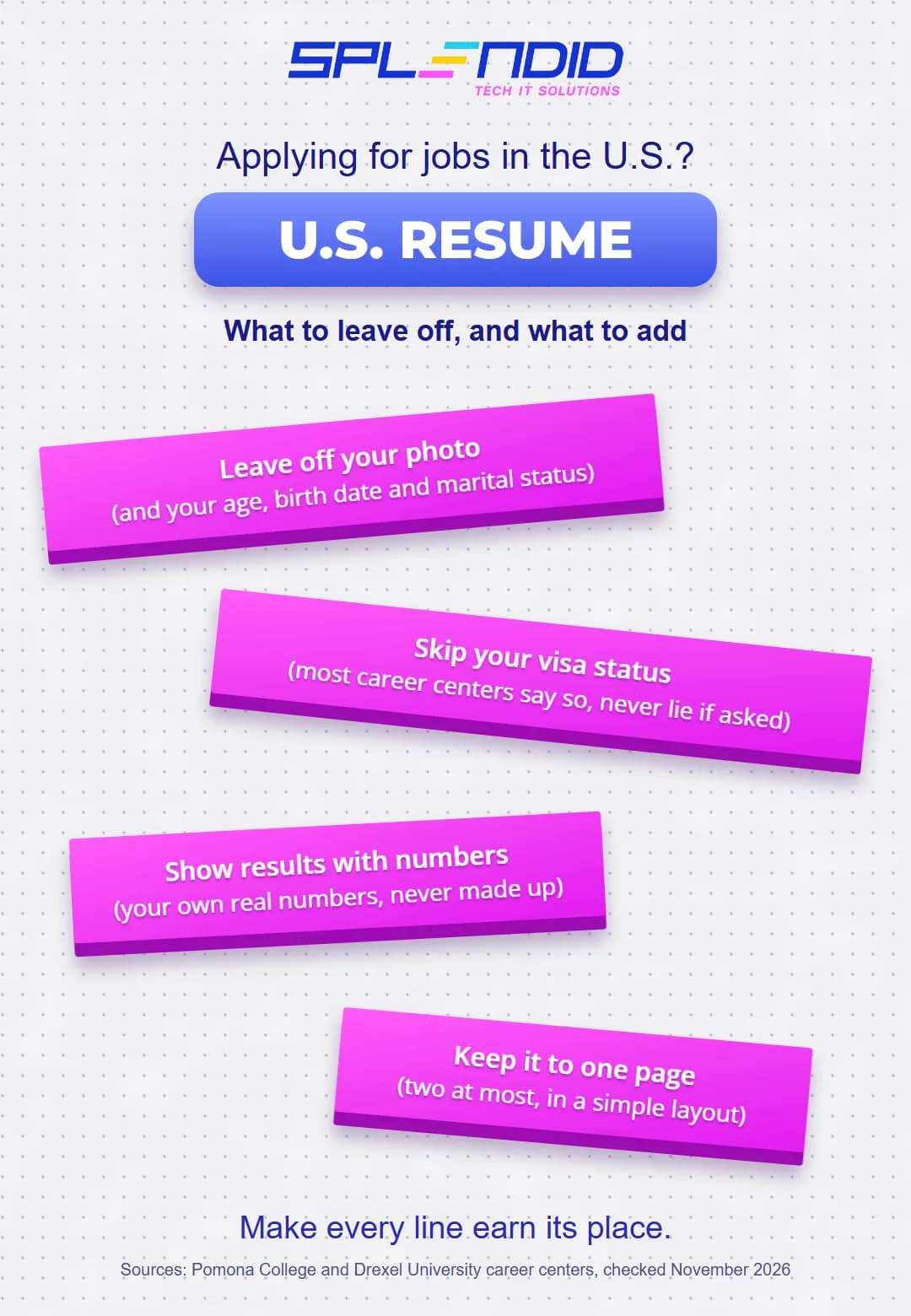
A U.S. resume for an international student should be one or two pages, with no photo and no personal details like age or marital status. It should focus on results: what you built, fixed or improved, with numbers where you have them. Career centers such as Pomona's and Drexel's also advise leaving your visa status off the resume.
If you wrote your first CV back home, some of this will feel different. Below we go section by section, then cover the visa question.
Key takeaways
- Keep it to one or two pages. If you're a new graduate, aim for one.
- Leave off your photo, age, date of birth, marital status and religion. U.S. resumes usually leave them out.
- Career centers like Drexel's and Pomona's say not to list your visa status. Never lie about it if you're asked.
- Show what changed because of your work, with numbers when you can.
- Match your skills to the job description, using the employer's own words where they're true for you.
- Keep the layout simple, so both people and software can read it.
How a U.S. resume is different from a CV back home
Your CV back home may have had a photo, your date of birth or your marital status. In the U.S., these usually stay off.
Pomona College's career office tells international students: "Do not include your age/birth date, marital status, race, religion, or visa status," and "Do not include your photograph on the résumé." On length, it says the resume "is limited to 1-2 pages maximum."
Leaving these details off is normal in the U.S., so it won't look strange.
Should you put your visa status on your resume?
The career centers we checked give the same answer.
Drexel University's career center says: "Your visa status should not be included on your résumé." It also says: "You should never lie about your visa status." Pomona's guide, quoted above, says the same.
Employers often ask about work authorization on the application form or on the first call with a recruiter. That's the place to answer honestly. Our guide on how to answer "Do you require visa sponsorship?" has scripts you can adapt.
Advice can differ from school to school, so ask your own career center if you're unsure.
Section by section: what to include
Contact details. Your name, U.S. phone number, a professional email, your LinkedIn URL, and your city and state. Skip your full street address and any home-country address.
Education. For new graduates, this usually goes near the top. List your U.S. degree first, then any degree from home. Write the degree name in English, add your graduation month and year, and include relevant courses if they fit the job. Add your GPA if it helps you.
Experience. Internships, jobs, CPT internships (work you did through your school's Curricular Practical Training), research and teaching assistant work all count, and so does work you did before your master's. Write three to five bullets for each role.
Projects. If you don't have much U.S. work experience yet, strong projects can help make up for it. Pick two or three that match the job, and describe them like work experience: what you built, the tools you used, and what happened.
Skills. List the tools and languages the job asks for, like SQL, Python, Tableau or AWS, if you really know them. Group them simply, for example languages, tools and cloud.
Languages. Pomona's guide suggests listing your languages, with this example: "Native speaker of Mandarin and proficient in Spanish." If you've worked across countries, say so in your experience bullets.
How to write strong bullets
Many resumes list duties: "Responsible for data analysis." Recruiters want to know what changed because of you.
Try this pattern: what you did, how you did it, and the result.
- Before: "Responsible for creating reports for the sales team."
- After (example): "Built a weekly sales dashboard in Power BI that cut manual reporting from 4 hours to 30 minutes."
Use your own real numbers. If you don't have exact figures, an honest estimate ("about 20 users", "roughly half the time") still helps. Never make numbers up. Interviewers may ask about them.
Start each bullet with a clear verb: built, launched, automated, reduced, analyzed, led, designed.
Match the job description, honestly
Many employers, especially larger ones, use applicant tracking software (ATS), which stores applications and lets recruiters search them by keyword. So use the words the job post uses, as long as they're true for you.
If the post says "stakeholder communication" and you presented results to a client every week, say it in those words. If it asks for a skill you don't have, leave it out. Expect questions on anything you put on your resume.
You don't need a new resume for every application. Keep one main version for each type of role, then adjust your top skills and two or three bullets for each job.
Keep the format simple
Keep the design plain. A simple layout is easier for people to scan and easier for software to read.
- Use one column and standard headings: Education, Experience, Projects, Skills.
- Avoid tables, text boxes, icons and graphics, especially at the top of the page.
- Pick a common font at 10 to 12 points.
- Save it as a PDF unless the employer asks for Word.
- Name the file clearly: FirstName-LastName-Resume.pdf.
Common mistakes international students make
- Keeping the CV format from home, with a photo, date of birth or a long personal section.
- Opening with an "Objective" about what you want. If you want an opening line, a short summary of what you offer is more useful. You can also skip it.
- Listing every course and certificate. Keep only what helps for this job.
- Putting your strongest work on page two. Put your best, most relevant experience first.
- Small English mistakes. Ask a friend or your career center to proofread. A single typo can be noticed.
A quick checklist before you apply
- One page, two at most
- No photo, age, date of birth, marital status, religion or visa status
- Contact details with a U.S. phone number and your LinkedIn URL
- Bullets that show results, with real numbers
- Skills that match the job post, and that you can talk about
- A simple, one-column layout, saved as a PDF
If you've sent dozens of applications and heard almost nothing back, the resume is often the first thing to check. Our Resume Overhaul service rebuilds your resume for the exact role you're targeting.
Want someone to check your resume?
Splendid Tech works one-on-one with international students on their U.S. job search. We'll look at your resume next to the jobs you want and tell you honestly what to fix first.
Book a Free Strategy Call to talk it through.
Information only: this article shares general information, not legal or immigration advice. For questions about your own status, ask your school's DSO or an immigration attorney.
Frequently asked questions
Should international students put their visa status on their resume?
The career centers we checked advise against it. Drexel University's career center says your visa status should not be included on your résumé, and also says you should never lie about it. Employers often ask about work authorization on the application form or in the first recruiter call.
How long should a U.S. resume be?
One or two pages. Pomona College's career office says the resume is limited to one to two pages maximum. If you're a new graduate, aim for one page.
Should I put a photo on my U.S. resume?
No. U.S. resumes usually leave the photo off. Pomona College's career office says not to include your photograph on the résumé.
What personal details should I leave off a U.S. resume?
Pomona College's career office lists age or birth date, marital status, race, religion and visa status. Include your name, U.S. phone number, professional email, LinkedIn URL, and your city and state.
What if I don't have U.S. work experience?
Use projects, internships, research, teaching assistant roles and work from before your degree. Describe each one with what you did, how you did it and the result.
Should I use a different resume for every job?
Keep one main version for each type of role you're targeting. For each application, adjust your top skills and two or three bullets to match the job post, as long as everything stays true.
Stuck in your own job search?
Tell us where you are. We'll tell you honestly whether we can help.
Book a free call

