


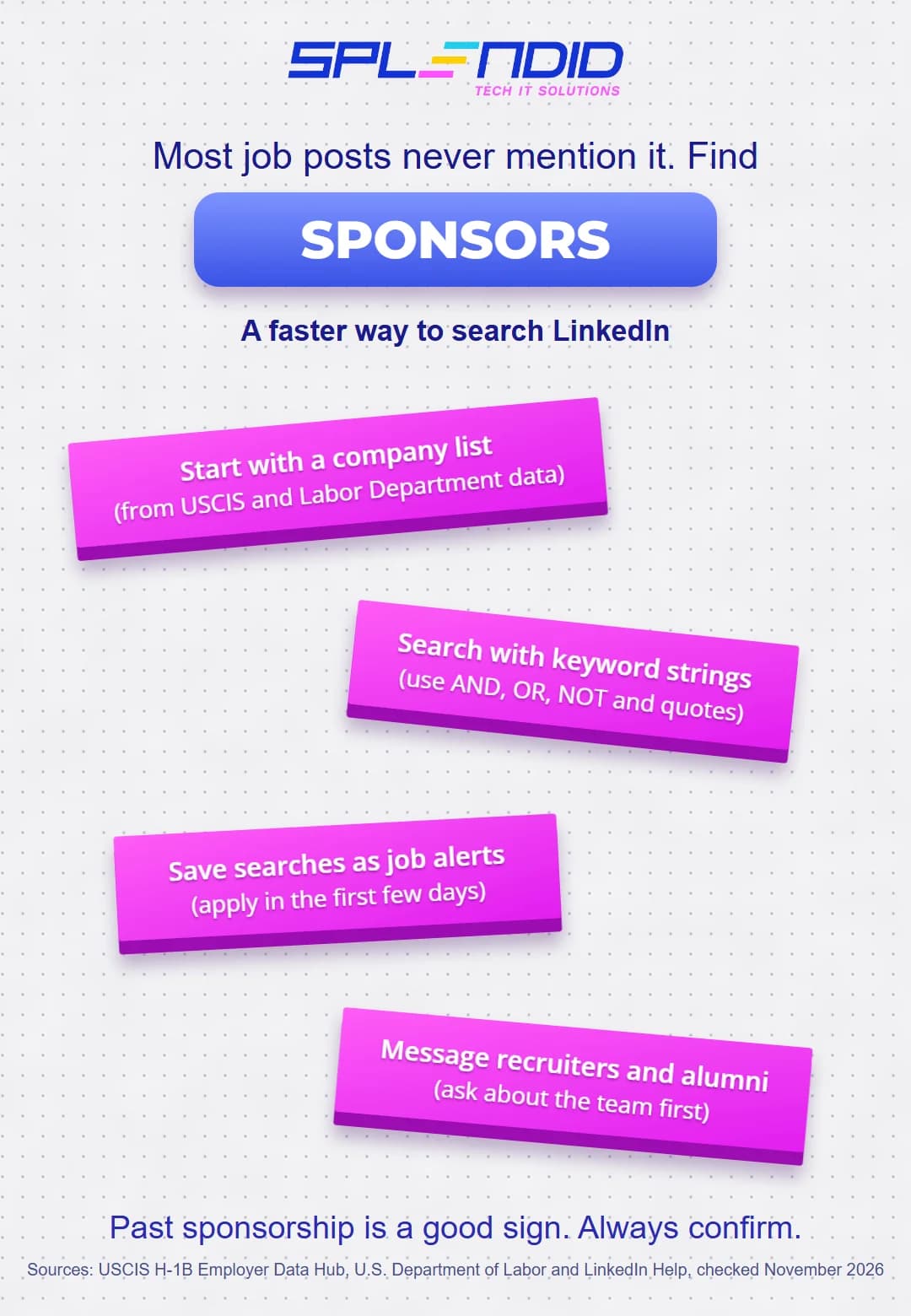
To find visa sponsorship jobs on LinkedIn, start with a list of companies that have sponsored before, using free public data from USCIS and the Department of Labor. Then search LinkedIn for roles at those companies with keyword strings, save the searches as job alerts, and reach out to recruiters and alumni there.
Typing "visa sponsorship" into the search box and scrolling is slow, because many job posts don't say either way. Working from the company side is faster. These five steps show how.
Key takeaways
- Start with a company list. Public USCIS and Department of Labor data shows which employers have hired H-1B workers or applied to.
- Use Boolean search on LinkedIn (special words like AND, OR and NOT that combine or exclude search terms) to find roles that mention sponsorship.
- Save your best searches as job alerts, so new posts come to you.
- Read the wording of each post. "Must be authorized to work without sponsorship" usually means no.
- Talk to people. A recruiter or alumni (graduates of your school) at a company can tell you things a filter can't.
Step 1: Build a list of companies that have sponsored before
A company that has filed H-1B petitions before already knows the process. That's a good sign, though not a promise. Three free, official places to check:
- The USCIS H-1B Employer Data Hub. According to USCIS, the data "can be queried by fiscal year, employer name, city, state, zip code, and NAICS code." (NAICS is an industry code. A fiscal year is the government's year, which runs from October to September.) You can look up a company you like, or search your city to find employers near you.
- Department of Labor disclosure data. Before an H-1B petition, employers file a Labor Condition Application (LCA) with the Department of Labor. The DOL's Office of Foreign Labor Certification publishes these files every quarter, organized by fiscal year. They're big spreadsheets, but they show employer names and job titles.
- ICE's list of top OPT employers. ICE's 2024 list of the Top 200 Employers for OPT and STEM OPT Students isn't about H-1B sponsorship, but it shows which companies are used to hiring international students.
Past filings don't promise that a company will sponsor your role today. One team may sponsor while another doesn't. Use the list as a place to start, then confirm with the company.
Aim for 20 to 40 companies that hire for your target role. If you're still applying to every role that fits your degree, narrow it down first. Our guide to getting a tech job on OPT shows how.
Step 2: Search LinkedIn with keyword strings
Now search LinkedIn for jobs at those companies, and for posts that mention sponsorship.
LinkedIn supports Boolean search. According to LinkedIn's help page, you can use quotation marks for exact phrases, AND, OR and NOT, and parentheses to group terms. It also says you "must type them in uppercase letters for the search to work correctly."
Copy these into the job search box and change the job title to yours:
- Roles that mention sponsorship: "data analyst" AND ("visa sponsorship" OR "H-1B" OR "H1B")
- Several job titles at once: ("software engineer" OR "backend engineer") AND ("sponsorship" OR "H-1B")
- Hide roles that say no to sponsorship: "business analyst" NOT ("without sponsorship" OR "U.S. citizen")
LinkedIn's help page explains Boolean search for the main search bar. In job searches the results can vary, so try each string, compare what comes back, and keep the ones that work.
Next, use LinkedIn's filters for location, experience level ("Entry level" or "Associate") and date posted ("Past week"). A new post has had less time to collect applicants.
Step 3: Turn your best searches into job alerts
When a search gives good results, save it as a job alert. LinkedIn will send you new matching posts, so you don't have to search from scratch every day.
For example:
- 2 or 3 alerts for keyword strings like the ones above
- 1 alert for each of your top 5 to 10 companies
Check your alerts once a day and apply to the best matches.
Step 4: Read the job post's wording carefully
What common phrases usually mean:
- "Visa sponsorship available" or "will sponsor": a good sign. Apply, and still confirm on the first call.
- "Must be authorized to work in the U.S. without sponsorship, now or in the future": this role probably won't sponsor. It's usually best to skip it.
- "U.S. citizens only" or "security clearance required": these roles are usually closed to visa holders.
- No mention at all: this is common. Check the company against your list from Step 1, then ask the recruiter.
Not sure what to say when an application asks about sponsorship? Our guide on how to answer "Do you require visa sponsorship?" has scripts you can adapt.
Step 5: Find recruiters and alumni at those companies
People inside a company know things a search can't show you, such as which teams hire international students.
In LinkedIn's main search bar, switch to People and try searches like:
- "technical recruiter" AND "Acme" (replace Acme with the company)
- "university recruiter" OR "campus recruiter", then filter by company
- your school's name, then filter by company, to find alumni
Send a short, personal message. Ask about the team and the role first. Once you're talking, you can ask whether the team hires international students. Our guide on how to get a referral as an international student has message templates you can adapt.
Mistakes to avoid
- Trusting the word "sponsorship" on its own. Some posts mention it only to say no, so read the full sentence.
- Applying everywhere. A short list of companies you've checked is worth more than hundreds of random applications.
- Waiting too long. Turn on alerts and apply soon after a post goes up.
- Paying to get hired. Be very careful with any agency or post that asks you to pay a fee for a job or for sponsorship. Talk to your school's international office before you pay anything.
- Hiding your status. Employers usually ask about work authorization early, often on the application. Answer honestly from the start.
A simple weekly routine
- Once: build your company list from USCIS and DOL data.
- Every day, about 15 minutes: check your job alerts and apply to the best two or three matches.
- Twice a week: message two or three recruiters or alumni at companies on your list.
- Every week: update your list. Drop companies that said no, and add new ones.
The hardest part is usually choosing the right role and the right companies before you apply. Our Career Strategy & Role Clarity service helps you pick both, so your applications go where they can work.
Want help with your company list?
Splendid Tech works with international students on exactly this. We'll help you build a list of employers that hire for your role, then plan how to reach them.
Book a Free Strategy Call to talk it through.
Information only: this article shares general information, not legal or immigration advice. Rules change, so check the official sources linked above and confirm your own situation with your school's DSO or an immigration attorney.
Frequently asked questions
Does LinkedIn have a visa sponsorship filter?
Don't count on filters alone. Many job posts don't mention sponsorship either way. Use keyword searches like "visa sponsorship" OR "H-1B", and check companies against public USCIS and Department of Labor data.
How do I know if a company has sponsored H-1B workers before?
Look the company up in the USCIS H-1B Employer Data Hub, which can be searched by fiscal year, employer name, city, state, zip code and NAICS code. The Department of Labor also publishes quarterly Labor Condition Application data. Past filings don't promise a company will sponsor your role, so confirm with the recruiter.
What Boolean search operators work on LinkedIn?
According to LinkedIn's help page, you can use quotation marks for exact phrases, AND, OR, NOT, and parentheses to group terms. AND, OR and NOT must be typed in uppercase.
What does "must be authorized to work without sponsorship" mean?
It usually means the employer won't sponsor a work visa for that role, now or later. If you'll need sponsorship in the future, it's usually best to focus on other roles.
Should I pay an agency to find me a sponsored job?
Be very careful with anyone who asks you to pay for a job or for sponsorship. Talk to your school's international student office before you pay anything.
How many companies should be on my target list?
A list of 20 to 40 companies that hire for your role is a good start. It's small enough to research properly and big enough to keep your search moving.
Stuck in your own job search?
Tell us where you are. We'll tell you honestly whether we can help.
Book a free call

